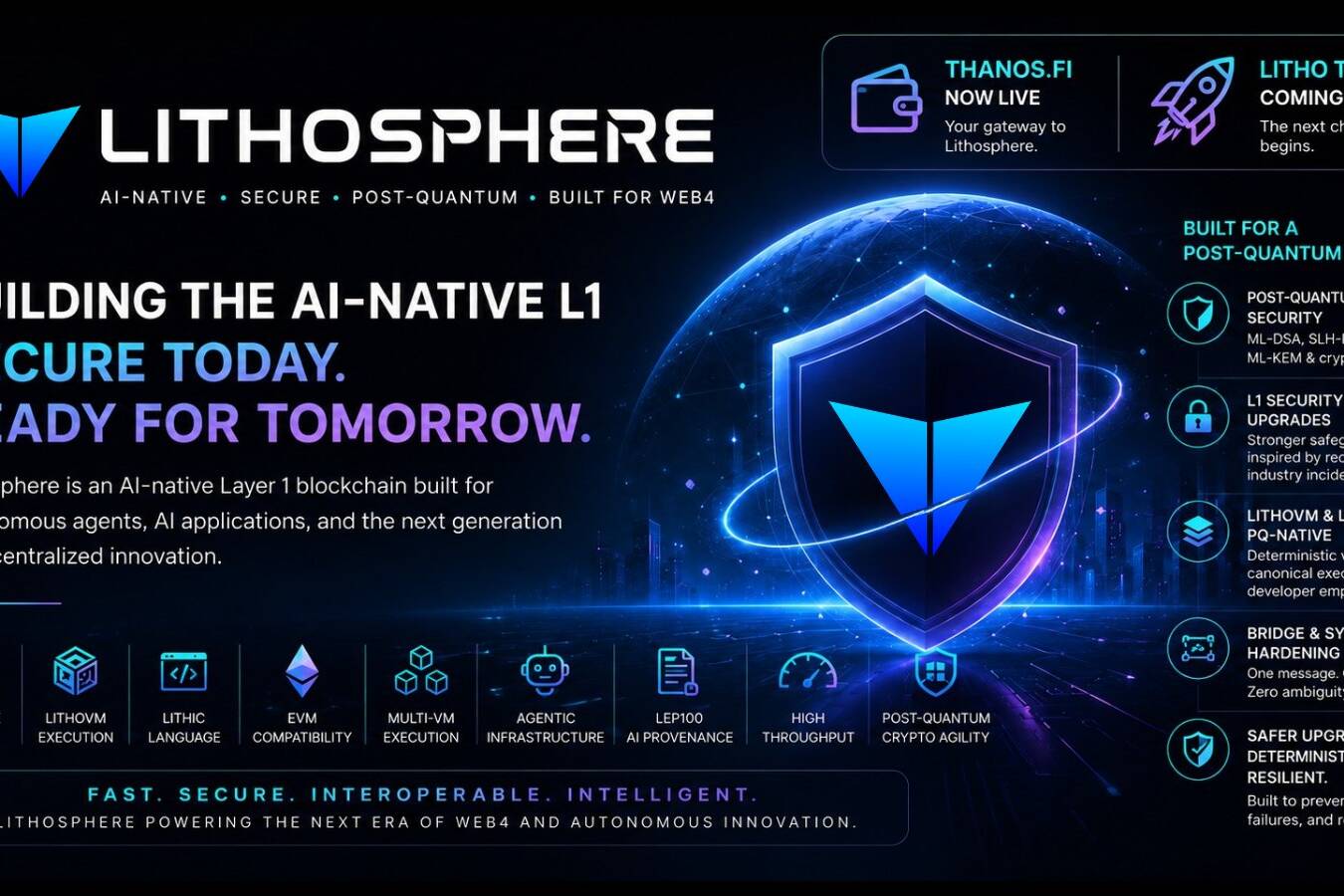
Identity, naming, execution, and cross-chain settlement are usually four separate integrations. On Lithosphere, they are one.
Spend enough time evaluating Web4 infrastructure and a pattern emerges. A team picks an identity protocol from one provider, a naming or discovery layer from another, an execution environment from a third, and then spends the next several months building the glue code that lets those three things actually talk to each other. None of it is wrong, exactly. It is just slow, and it puts the integration risk on whoever is building the application, not on the infrastructure providers who sold them three separate products.
Lithosphere’s answer to that problem is to not have three separate products in the first place. Lithic, PPAL, DNNS, and MultX are four components, but they share one architecture, which means an application built on Lithosphere is not stitching together vendors. It is building on a stack that was already designed to fit together before any of those pieces shipped.
Here is what that actually looks like in practice, broken into the pieces most multi-vendor stacks struggle to connect:
Identity. PPAL, built on the LEP100 standard, gives agents and users a persistent, privacy-aware identity. In a typical multi-vendor setup, this identity has to be re-verified or re-mapped every time it crosses into a different system, because the identity provider and the execution layer were never designed with each other in mind. On Lithosphere, identity established through PPAL carries forward natively into everything downstream.
Discovery. DNNS handles decentralized naming and routing, the part of the stack responsible for letting agents and services actually find each other. Bolted-on naming systems usually require their own resolution layer, which adds a hop, a delay, and one more place for something to break. DNNS was built as part of the same system as everything else, so resolution happens inside the same environment rather than across a separate lookup service.
Execution. Lithic provides the AI-native environment where agent tasks actually run, under verifiable, deterministic conditions. A typical stack would need this execution layer to call out to an external identity check and an external naming lookup every time it needs either, each call introducing its own latency and its own failure surface. On Lithosphere, those calls do not have to leave the architecture.
Settlement. MultX coordinates cross-chain activity, letting assets and execution move across networks without anchoring to a single chain. This is usually the piece that breaks multi-vendor setups the hardest, because cross-chain settlement built on top of three other already-integrated systems compounds every integration gap that came before it. MultX does not inherit those gaps, because there were none to inherit.
Put the four together and the difference is not really about any single feature. It is about what a developer does not have to build. An application built on a fragmented stack spends real engineering time making identity, discovery, execution, and settlement aware of each other. An application built on Lithosphere gets that awareness by default, because the stack was never four separate things pretending to be one.
That matters more now than it would have eighteen months ago. Autonomous agents are increasingly expected to handle multi-step jobs without a human re-authorizing each step: verify a counterparty, locate a service, execute a task, settle the resulting payment across chains. Every handoff between systems in that chain is a place where a fragmented stack can lose context, and a place where Lithosphere’s integrated stack simply does not, because there was never a handoff to begin with.
None of this means assembling infrastructure from multiple specialized providers is a bad strategy in every case. Sometimes it is the only option available. But it is worth being honest about what that strategy costs in integration time, ongoing maintenance, and the number of places a single update can quietly break something downstream. Lithosphere’s bet is that most teams building serious agent infrastructure would rather not pay that cost at all, and would rather start from a stack that was already whole.