Most people still think blockchain competition is about:
- faster transactions
- lower fees
- better user experience
But another race has already started underneath the surface.
The race to become the execution layer for autonomous agents.
Agents Change What Infrastructure Needs to Do
Traditional blockchain systems were designed around users.
A user:
- signs a transaction
- interacts with an application
- completes an action
Agents behave differently.
They:
- execute continuously
- interact autonomously
- coordinate across systems
- consume and process data constantly
This creates a completely different infrastructure requirement.
Why Current Systems Struggle
Most existing chains were not designed for:
- persistent execution
- intelligent coordination
- programmable identity
- machine-to-machine interaction
As agent activity scales, these limitations become more visible.
Execution becomes fragmented.
Coordination becomes externalized.
Identity becomes inconsistent.
The result is infrastructure friction.
The Shift From Apps to Systems
Previous blockchain cycles focused heavily on applications.
But agents operate at the system level.
They require:
- execution environments
- coordination layers
- identity infrastructure
- verifiable interaction models
This changes where value begins to accumulate.
The focus moves beneath the application layer.
Why Identity Matters for Agents
Agents cannot operate reliably without identity.
They need:
- permissions
- continuity
- trust
- verifiable history
Without identity infrastructure, agents remain temporary execution processes.
With persistent identity systems like PPAL:
- agents maintain continuity
- interactions become traceable
- coordination becomes scalable
Identity becomes part of execution itself.
Coordination Becomes Critical
Agents rarely operate alone.
They:
- interact with other agents
- coordinate across chains
- access distributed liquidity and services
This requires infrastructure capable of:
- synchronized execution
- cross-network coordination
- structured interaction
Without this, systems fragment quickly.
Why Execution Needs Structure
AI introduces variability.
Blockchain requires consistency.
That tension is becoming one of the defining infrastructure challenges of Web4.
Execution environments must support:
- adaptive behavior
- deterministic control
- verification frameworks
- governed execution flows
This is where intelligent execution infrastructure becomes critical
Why Capital Is Moving Toward Infrastructure
As markets mature, infrastructure becomes increasingly important.
Applications come and go.
Infrastructure compounds.
And if autonomous systems become long-term participants in decentralized ecosystems, the execution layers beneath them become strategically valuable.
This is why infrastructure-focused ecosystems are increasingly attracting attention ahead of large-scale agent adoption.
Lithosphere’s Positioning
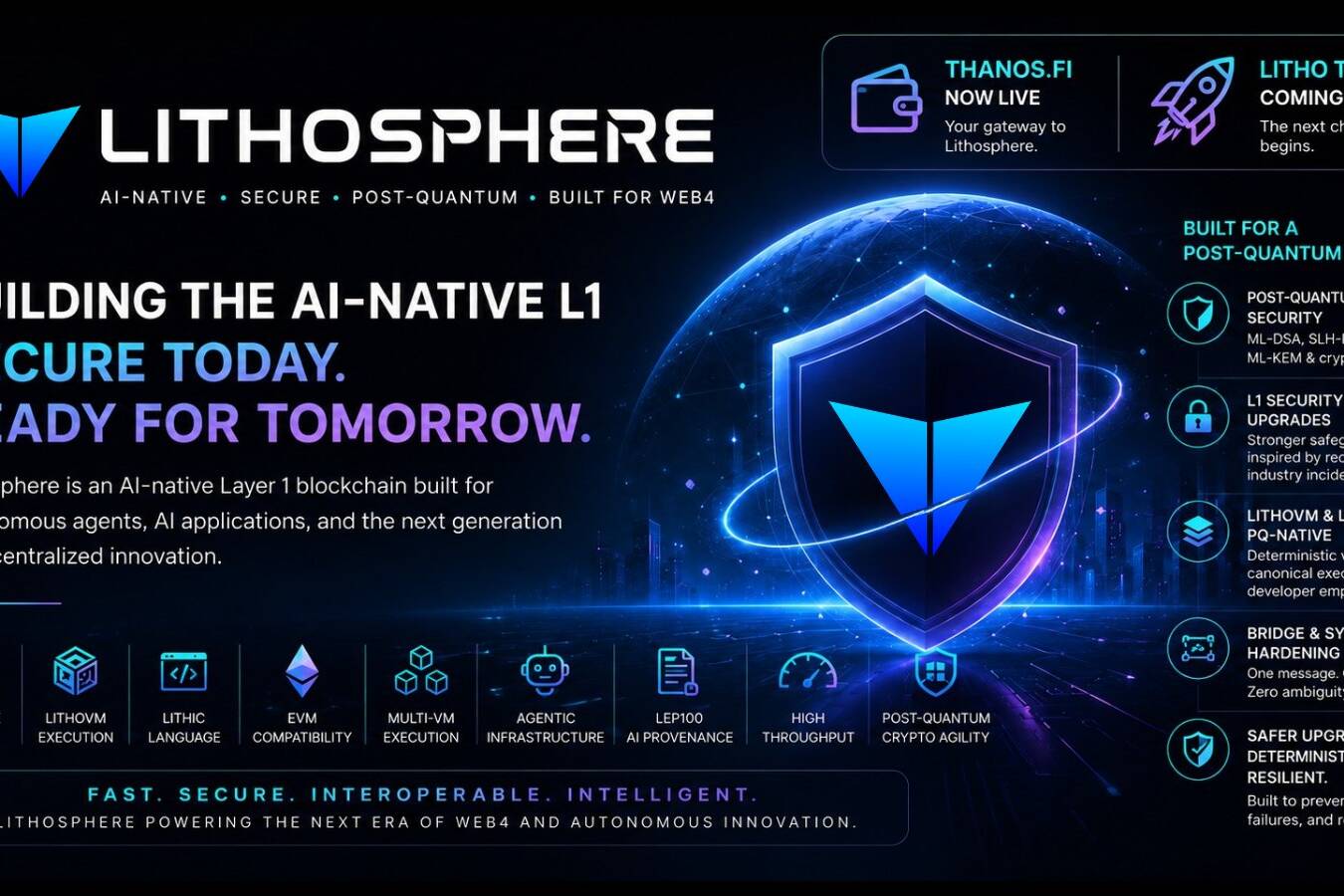
Lithosphere is being built specifically around these requirements.
The ecosystem combines:
- Lithic for AI-native execution
- PPAL for programmable identity
- MultX for cross-chain coordination
- LEP100 for verification and governance
- DNNS for decentralized routing and discoverability
Together, these systems create infrastructure designed for agents operating continuously onchain.
Not temporary AI integrations.
Persistent intelligent systems.
The Long-Term Shift
The market is gradually moving:
From:
- transaction-focused infrastructure
To:
- intelligent execution infrastructure
From:
- isolated applications
To:
- autonomous coordinated systems
This is a much larger transition than another blockchain cycle.
It changes how decentralized infrastructure itself is designed.
Final Thought
The next generation of blockchain infrastructure will not be defined solely by speed or fees.
It will be defined by whether intelligent systems can operate reliably on top of it.
Because once agents become active participants in decentralized economies, infrastructure stops being background technology.
It becomes the foundation of everything that follows.